
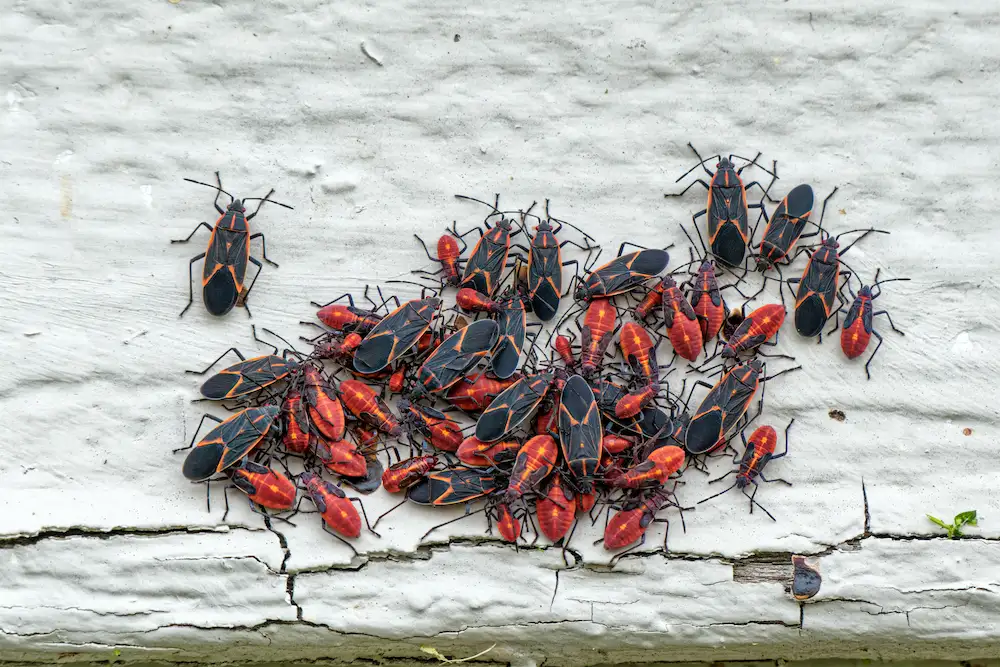
If you notice groups of black-and-red insects gathering around your windows, siding, or doors as summer ends, you may be dealing with boxelder bugs. They become especially noticeable in Edmonton during fall as temperatures begin to drop.
These insects are not considered dangerous to people or pets, and they generally do not cause structural damage. The problem is their numbers. Large groups can gather around a home, with some eventually finding their way indoors.
Understanding why they appear in fall can make them easier to manage.
What Are Boxelder Bugs?
Boxelder bugs are small, dark-coloured insects with distinctive red or orange markings. Adults are usually around 12–14 mm long.
They are sometimes called maple bugs because they can also be associated with maple trees. They feed mainly on seeds and plant material outdoors.
Unlike many household pests, boxelder bugs are not coming inside because they are looking for food. They are mainly looking for shelter as temperatures fall.
Why Do Boxelder Bugs Invade Homes in Fall?
The main reason is the changing weather.
During late summer and early fall, boxelder bugs often gather on sunny exterior walls. South- and west-facing surfaces are especially attractive because they receive more sunlight and stay warmer.
As temperatures drop, the insects move toward cracks, gaps, window frames, foundations, and other sheltered areas.
Your home can provide a protected place for them to overwinter. This is why a property can suddenly have a boxelder bug problem even when there were few insects around it during summer.
When Do Boxelder Bugs Enter Homes in Edmonton?
The main period is late summer through fall, particularly when warm afternoons begin giving way to colder nights.
The exact timing depends on the weather. Warm, sunny days can encourage large groups to gather outside, while colder conditions push them toward protected spaces.
This makes early fall an important time to inspect your home.
If you notice large clusters outside, check the building for potential entry points before the insects start appearing indoors.
How Do Boxelder Bugs Get Inside?
A boxelder bug does not need a large opening to enter a home. Small gaps around the exterior can be enough.
Common entry points include:
- Cracks around windows and doors
- Damaged or missing screens
- Gaps around vents and utility openings
- Openings around siding and soffits
- Cracks around the foundation
Pay particular attention to areas where you already see insects gathering. A large cluster around one window or section of siding may indicate an entry point nearby.
Are Boxelder Bugs Harmful to People, Pets, or Homes?
Generally, no. Boxelder bugs are nuisance pests rather than dangerous household pests.
They do not normally bite or sting people, and they do not cause structural damage.
The bigger issue is their numbers. Large groups can become difficult to ignore when they crawl across walls, windows, curtains, and other surfaces.
If crushed, they can release an unpleasant odour and may leave reddish or orange staining. It is therefore better to remove them without squashing them against walls or furniture.
Why Do I Keep Getting Boxelder Bugs Every Fall?
If the same property gets boxelder bugs every year, there may be a combination of nearby food sources and favourable shelter.
Boxelder, maple, and ash trees can support populations during warmer months. When fall arrives, adults may move from those trees toward nearby buildings.
Removing one tree does not necessarily solve the problem. Bugs can travel from other trees nearby.
The building itself may also contribute. If insects enter through the same cracks every year, those openings remain available during the next fall migration.
How Can You Prevent Boxelder Bugs from Coming Inside?
The most useful approach is to focus on exclusion before the insects move indoors.
Check windows, doors, vents, screens, foundation joints, and siding for small gaps.
A few practical steps can help:
- Seal entry points. Repair damaged screens and seal gaps around windows, doors, and other openings.
- Inspect sunny walls. Pay particular attention to south- and west-facing surfaces where insects gather.
- Reduce nearby shelter. Remove unnecessary debris and other sheltered areas close to the house.
- Watch host trees. Boxelder and maple trees can support populations that later move toward buildings.
The goal is not necessarily to eliminate every boxelder bug outdoors. It is to reduce the number reaching your home and make it harder for them to get inside.
What Should You Do If Boxelder Bugs Are Already Inside?
If you are only seeing a few, physical removal is often the simplest option.
A vacuum can collect insects without crushing them against a wall. Dispose of the contents promptly.
Avoid relying on indoor spraying as the first response. The insects inside may simply be the visible part of a larger seasonal problem around the exterior.
Instead, look for where they are coming from. Check windows, doors, screens, and exterior gaps where you see repeated activity.
If insects continue appearing despite reasonable exclusion efforts, the entry points may be difficult to locate. Large numbers throughout the house are also a reason to consider a closer assessment.
For more information about managing insect problems around Edmonton homes, see our insect control resources.
Can You Get Rid of Boxelder Bugs Permanently?
There is an important difference between killing the insects you see and preventing the next seasonal invasion.
Removing visible bugs does not close the openings they are using. It also does not eliminate nearby sources of the population.
Long-term control means reducing access to the building, addressing recurring entry points, and dealing with significant outdoor activity at the right time of year.
If a property experiences large numbers every fall, professional assessment can help identify where the insects are gathering and how they are getting inside.
At We Clean Pest Control, we focus on identifying the actual pest problem before recommending treatment rather than automatically choosing the most expensive option. Learn more about boxelder bug control in Edmonton.
When Should You Call a Professional?
A few boxelder bugs around a window do not necessarily mean professional treatment is needed.
However, help can be useful when numbers are increasing quickly, insects are appearing throughout the house, or the problem returns every fall despite your prevention efforts.
It is also worth getting an assessment when you cannot identify the entry points or large outdoor clusters are forming around the building.
For an overview of residential pest management in Edmonton, see our residential pest control information.
Frequently Asked Questions About Boxelder Bugs in Edmonton
Why are there so many boxelder bugs around my house?
Large groups usually appear when seasonal conditions cause adults to gather on warm, sunny surfaces before seeking shelter for winter. Nearby boxelder, maple, or ash trees can contribute to the population.
Do boxelder bugs bite?
Boxelder bugs do not normally bite or sting people or pets. Their main issue is nuisance activity, especially when large numbers gather around buildings or enter homes.
What is the best way to get rid of boxelder bugs inside?
For a small number, vacuuming is a practical way to remove them without crushing them. The more important long-term step is finding and sealing the openings they use to enter.
Will removing a boxelder tree stop the problem?
It may reduce the local population, but it does not guarantee that boxelder bugs will disappear. Bugs can come from other trees nearby, so tree management works best alongside exclusion and other preventive measures.
Stop Boxelder Bugs Before They Get Inside
Boxelder bugs invade Edmonton homes in fall because they are looking for protected places to survive the winter.
Large clusters on warm exterior walls are an important warning sign. Instead of waiting until dozens of insects appear indoors, inspect screens, windows, doors, vents, siding, and other potential entry points.
For recurring or heavy problems, We Clean Pest Control can help identify the source and determine what level of control makes sense for your property.
