
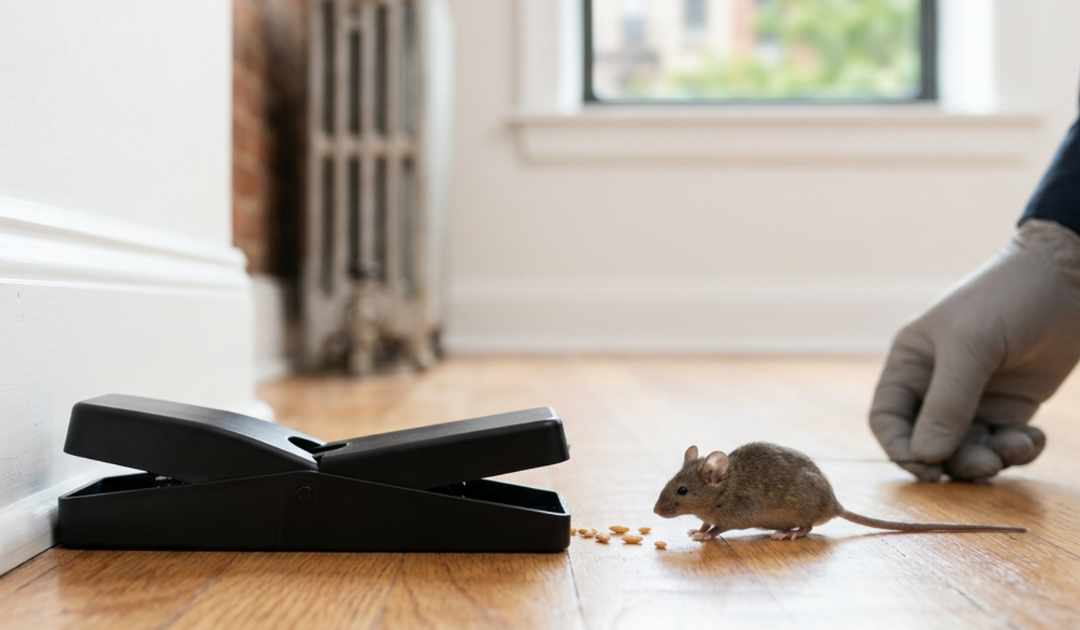
Finding a mouse in your apartment can be unsettling. Even one sighting often means there is more going on behind the walls than you can see. Unlike detached homes, apartment buildings have shared walls, ceilings, utility lines, and pipe openings that allow mice to travel from one unit to another. That is why a problem that seems isolated can quickly become a building-wide issue.
The good news is that mice can be eliminated. The key is acting early and focusing on the source of the infestation rather than only the mouse you happened to see.
In this guide, we explain how to get rid of mice in apartment settings, what attracts them in the first place, and which methods actually work for long-term control.
What Are the First Signs of Mice in an Apartment?
Many people never actually see a mouse until an infestation has already become established. Instead, they notice small warning signs that are easy to overlook.
Some of the most common indicators include:
- Small, dark droppings along baseboards or inside cupboards
- Scratching noises inside walls or ceilings at night
- Chewed food packaging or cardboard
- Shredded paper or fabric used as nesting material
- A musty or ammonia-like smell in enclosed spaces
- Grease marks along walls where mice regularly travel
If you notice several of these signs together, there is a strong chance you have mice in apartment spaces rather than a single stray rodent.
How Do Mice Get Into an Apartment?
People are often surprised to learn that mice do not necessarily enter through the front door.
Instead, they usually travel through hidden structural openings inside the building itself.
Common entry points include:
- Gaps around plumbing under sinks
- Openings behind kitchen appliances
- Utility pipe penetrations
- Cracks around windows and doors
- Ventilation ducts
- Shared walls between neighbouring apartments
This is one reason DIY trapping alone often falls short. If entry points remain open, new mice may continue entering even after others have been removed.
How to Get Rid of Mice in an Apartment
If you have confirmed mouse activity, it is important to combine several strategies rather than relying on a single solution.
1. Remove Food Sources
Even tiny amounts of food can sustain mice.
Store dry goods in sealed containers, wipe countertops daily, vacuum crumbs regularly, and avoid leaving dirty dishes overnight. Pet food should also be picked up after feeding whenever possible.
Reducing food availability makes your apartment far less attractive.
2. Seal Small Entry Points
Inspect areas beneath sinks, behind appliances, and around heating pipes.
Small cracks can often be sealed using appropriate materials such as caulk, while larger gaps may require steel wool combined with sealant because mice can chew through many common materials.
Keep in mind that some entry points may be located inside walls or common building areas that tenants cannot access themselves.
3. Use Traps Strategically
Snap traps remain one of the most effective DIY options for small infestations.
Place traps along walls where mice naturally travel rather than in open spaces. Mice prefer moving close to edges where they feel protected.
Using several traps at once usually produces better results than relying on a single trap.
Avoid moving traps every day, as mice become cautious around new objects.
Can One Apartment Have Mice If the Rest of the Building Doesn’t?
Sometimes yes, but often no.
Apartment buildings function as connected ecosystems. Mice easily move through wall voids, ceilings, and utility lines without residents ever seeing them.
This means a problem reported in one apartment may already involve neighbouring units.
For this reason, many property managers rely on pest control services for apartment blocks when rodent activity appears in more than one unit. Coordinated inspections and treatment across affected areas are typically far more successful than addressing each apartment individually.
Should You Tell Your Landlord If You Find Mice?
Yes.
If you rent your apartment, report signs of mice as soon as possible.
In many cases, landlords or property managers are responsible for arranging inspections or treatment, particularly when the infestation affects multiple units or common areas.
When reporting the issue, include:
- When you first noticed activity
- Where you found droppings or damage
- Whether you have seen live mice
- Photos if possible
Prompt reporting allows the problem to be addressed before it spreads further throughout the building.
When Should You Call a Professional?
DIY methods can help if you catch the problem early. However, they are often less effective when mice are nesting inside walls or moving between multiple apartments.
You should consider professional help if:
- You continue finding fresh droppings after setting traps.
- You hear scratching in the walls every night.
- You notice chewed wires or insulation.
- Multiple apartments have reported mouse activity.
- The infestation returns after several weeks.
These situations usually indicate that removing individual mice is not enough. The source of the infestation also needs to be identified.
At We Clean Pest Control, we often see apartment infestations where the visible mice are only a small part of the problem. A proper inspection can identify how rodents are entering the building and where they are nesting, allowing treatment to focus on the root cause instead of only the symptoms.
Can Mice Come Back After They Are Gone?
Yes. Removing mice is only half the job.
If the conditions that attracted them remain, new rodents can eventually move into the same space. Apartments are especially vulnerable because neighbouring units may still have active infestations, allowing mice to travel through shared walls and utility lines.
Long-term prevention should include:
- Sealing accessible entry points
- Keeping food in airtight containers
- Cleaning crumbs and spills promptly
- Reducing clutter around storage areas
- Reporting new signs of activity immediately
Even after successful treatment, regular inspections help catch new activity before it develops into another infestation.
What if Traps Are Not Catching Anything?
This is one of the most common frustrations.
If you know mice are present but traps remain untouched, several factors may be responsible.
For example, traps may be placed in areas where mice rarely travel. They may also be competing with easily available food elsewhere in the apartment. In some cases, the infestation is actually occurring inside the walls, making it difficult for mice to reach the traps at all.
When trapping produces little or no progress despite ongoing signs of activity, professional inspections are often the fastest way to locate hidden nesting areas and travel routes.
Homeowners and property managers looking for mice removal services in Edmonton should look for providers that inspect the entire situation rather than simply placing additional traps.
Frequently Asked Questions
What is the fastest way to get rid of mice in an apartment?
The fastest approach combines sanitation, sealing entry points, and properly placed traps. If mice continue appearing after these steps, professional treatment is usually the quickest way to eliminate the infestation.
Can mice leave an apartment on their own?
It is unlikely. If mice have access to food, water, and shelter, they have little reason to leave voluntarily. Without removing what attracts them, the problem typically becomes worse over time.
Is seeing one mouse a sign of an infestation?
Not always, but it should never be ignored. One mouse may indicate there are others hiding inside walls, ceilings, or neighbouring apartments. A prompt inspection helps determine whether it is an isolated incident or part of a larger problem.
Should I use poison in an apartment?
Poison is generally not the first choice in apartment buildings. Mice may die inside inaccessible wall cavities, creating unpleasant odours and making removal difficult. The most appropriate treatment depends on the building layout and the severity of the infestation.
The Key to Long-Term Mouse Prevention
Dealing with mice in apartment buildings can feel overwhelming, but the problem is manageable when addressed early. Rather than focusing only on the mouse you see, it is important to identify why rodents entered in the first place and how they are moving through the building.
If basic prevention measures and trapping are not solving the issue, professional assistance may be the most effective next step. At We Clean Pest Control, we help Edmonton residents identify the source of mouse activity and develop practical, long-term solutions that minimize disruption while preventing future infestations. Acting quickly not only protects your apartment but also helps stop mice from spreading to neighbouring units.

Recent Comments