
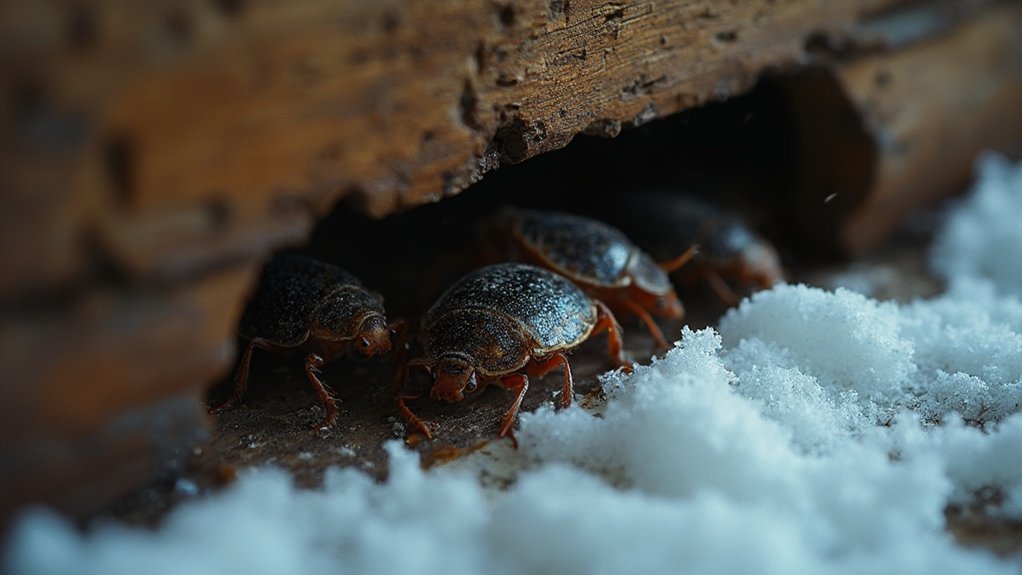
If you live in Edmonton, it is easy to wonder whether a long stretch of winter weather can solve a bed bug problem. After all, temperatures can stay well below freezing for days.
Unfortunately, putting an infested item outside or turning down the heat is not a reliable way to eliminate bed bugs. These pests can tolerate cold conditions, and simply becoming inactive does not mean they are dead.
The difference comes down to temperature, exposure time, and whether the cold reaches every part of the infested item.
Can Bed Bugs Survive in the Cold?
Yes. Bed bugs can survive cold temperatures, particularly when the temperature is not low enough or the exposure does not last long enough.
Cold slows their activity and metabolism. This can make them appear dead when they are actually still alive. The EPA specifically warns that bed bugs can become dormant in cold conditions and become active again after warming.
This is why a cold bedroom, an unheated room, or a few hours outdoors in winter should not be considered a bed bug treatment.
In a heated Edmonton home, winter outside temperatures have even less effect on an infestation. Bed bugs hiding inside mattresses, furniture, walls, or other protected areas are insulated from outdoor conditions.
Do Bed Bugs Die in the Cold?
Eventually, sufficiently cold temperatures can kill bed bugs. But ordinary winter weather is not a dependable treatment.
Research and pest-control guidance show that cold treatment needs sustained exposure to temperatures around 0°F (-18°C) or lower. The EPA states that cold treatments below 0°F (-19°C) for at least four days can eliminate bed bugs, although home freezers may not reliably reach or maintain the required temperature.
The important point is that temperature alone is not enough. The cold must reach the bugs and remain there long enough to kill them.
A thick suitcase, folded blanket, stuffed toy, or piece of furniture can take considerable time to reach the target temperature internally. The air temperature around an object can therefore be cold enough while bed bugs hidden deep inside remain protected.
How Cold Does It Have to Be to Kill Bed Bugs?
For controlled freezing, a useful benchmark is 0°F (-18°C) or colder for several days.
The University of Minnesota Extension states that all stages of bed bugs can be killed when objects are placed in a freezer at 0°F for three days. Other guidance, including the EPA, recommends four days below 0°F (-19°C), reflecting the importance of adequate exposure and the conditions of the item being treated.
Because different items and conditions affect how quickly the centre reaches the required temperature, it is safer to treat the time requirement as a minimum rather than assuming a short freeze will work.
| Cold Treatment | What It Means |
| Cool but above freezing | Bed bugs may survive and remain inactive |
| Around 0°C (32°F) | Activity slows, but this is not a reliable killing temperature |
| Around -18°C (0°F) | Sustained exposure can kill all life stages |
| Below -18°C | Lower temperatures can make treatment more effective, provided exposure is long enough |
The temperature inside the item matters, not just the temperature of the freezer.
Do Freezers Kill Bed Bugs?
Yes, a freezer can kill bed bugs if it maintains a sufficiently low temperature for long enough.
However, not every household freezer is reliable for this purpose. The EPA recommends checking the actual temperature with a thermometer because some home freezers do not get cold enough.
For small, suitable items, freezing can therefore be a practical supplemental method. The item should be contained so bed bugs cannot escape during handling, and the freezer must maintain the required temperature for the full treatment period.
Freezing is much less practical for large objects such as mattresses, sofas, upholstered furniture, or heavily infested rooms.
It also does nothing to address bed bugs that are hiding somewhere else in the home.
Will Putting Bed Bug-Infested Items Outside in Winter Work?
Not reliably.
Edmonton winters may produce temperatures well below freezing, but outdoor conditions fluctuate. An item may warm up during the day, receive sunlight, or never reach the required temperature throughout its centre.
The University of Minnesota Extension specifically notes that leaving infested furniture outdoors during winter may kill some bed bugs, but it will not necessarily kill all of them.
There is also a practical problem: moving an infested mattress, chair, bag, or piece of clothing outside can spread bed bugs through the home.
For that reason, winter weather should not be treated as a substitute for controlled freezing or professional treatment.
Can You Kill Bed Bugs by Turning Off the Heat?
No.
Simply making your home cold is not a reliable way to eliminate an infestation. Bed bugs can survive cooler conditions, and the temperature inside walls, furniture, mattresses, and other hiding places may remain different from the room temperature.
The EPA also warns against using unsafe DIY methods to manipulate indoor temperatures. Freezing by opening windows or using other uncontrolled methods may not get cold enough to kill the bugs.
If your goal is to eliminate bed bugs from an entire home, controlled treatment is much more dependable than trying to turn Edmonton’s winter weather into a pest-control method.
Is Cold Better Than Heat for Bed Bugs?
Cold can work, but heat is generally more practical for treating larger areas and objects.
Professional heat treatment works by raising temperatures throughout the treated space so that bed bugs and their eggs are exposed to lethal temperatures. The EPA notes that heat treatments are designed to reach temperatures high enough to kill bed bugs at all life stages, including eggs.
Cold treatment has the opposite challenge: the entire object must become sufficiently cold and stay there long enough. That is manageable for certain small items but much harder for an entire room.
At We Clean Pest Control, we offer a bed bug heat treatment as a non-chemical treatment option. Our approach is based on treating the actual infestation rather than relying on a single DIY method.
What Should You Do With Items That Cannot Go in a Freezer?
Not everything in a home can safely be frozen.
Electronics, antiques, delicate materials, large furniture, and other valuables may be damaged by extreme temperatures or may simply be too large to treat effectively in a household freezer.
For washable clothing and bedding, laundering and high-heat drying can help reduce bed bugs. For other belongings, the appropriate method depends on the material and where the bugs are hiding.
The important thing is to avoid moving questionable items from room to room. Uncontrolled movement can spread an infestation before treatment begins.
For smaller belongings that are suitable for controlled temperature treatment, We Clean Pest Control also offers bed bug heat treatment equipment rental as another option to consider.
Why Doesn’t Cold Weather Eliminate a Whole Bed Bug Infestation?
The biggest problem is that bed bugs rarely stay in one exposed location.
They can hide in mattress seams, bed frames, furniture joints, cracks, baseboards, and other protected spaces. Even if one item becomes cold enough to kill the bugs inside it, other parts of the infestation may remain untouched.
This is why treating a visible bug or a single piece of furniture does not necessarily eliminate the infestation.
A successful treatment needs to account for the places where bed bugs actually hide, as well as the possibility of eggs surviving in untreated areas.
If you are still trying to determine whether what you are seeing is actually a bed bug infestation, our guide to bed bug facts covers the basic signs and behaviour to look for.
Frequently Asked Questions About Bed Bugs and Cold
Do Bed Bugs Survive in the Cold?
Yes. Bed bugs can survive cold conditions when temperatures are not low enough or exposure is not long enough. They may become inactive and appear dead, then become active again when temperatures rise.
Do Freezers Kill Bed Bugs?
Yes, freezing can kill bed bugs and their eggs when the freezer reaches approximately 0°F (-18°C) and the items remain at that temperature for several days. Use a thermometer to verify the temperature rather than assuming your freezer is cold enough.
Will Bed Bugs Die Outside in an Edmonton Winter?
Not necessarily. Outdoor temperatures fluctuate, and the cold may not penetrate deeply enough into an infested object or remain low for long enough. Putting belongings outside is therefore not a dependable way to eliminate an infestation.
Is Heat or Cold Better for Killing Bed Bugs?
Both extreme heat and controlled freezing can kill bed bugs, but they have different practical uses. Freezing can work well for certain small objects, while controlled heat is generally more suitable when an infestation affects a larger area.
Need Help Getting Rid of Bed Bugs?
Cold weather can kill bed bugs under the right conditions, but simply waiting for winter to do the work is unlikely to solve an infestation.
The important distinction is between cold enough to make bed bugs inactive and cold enough, for long enough, to kill them. If the temperature and exposure time are not controlled, surviving bugs can become active again.
For an established infestation, the goal should be a treatment that reaches the places where bed bugs and their eggs are actually hiding. We Clean Pest Control focuses on identifying the real problem and recommending the most appropriate solution rather than unnecessary treatment.
